🎙️Leo Community AMA Recap
Highlights from Our Latest Community Call
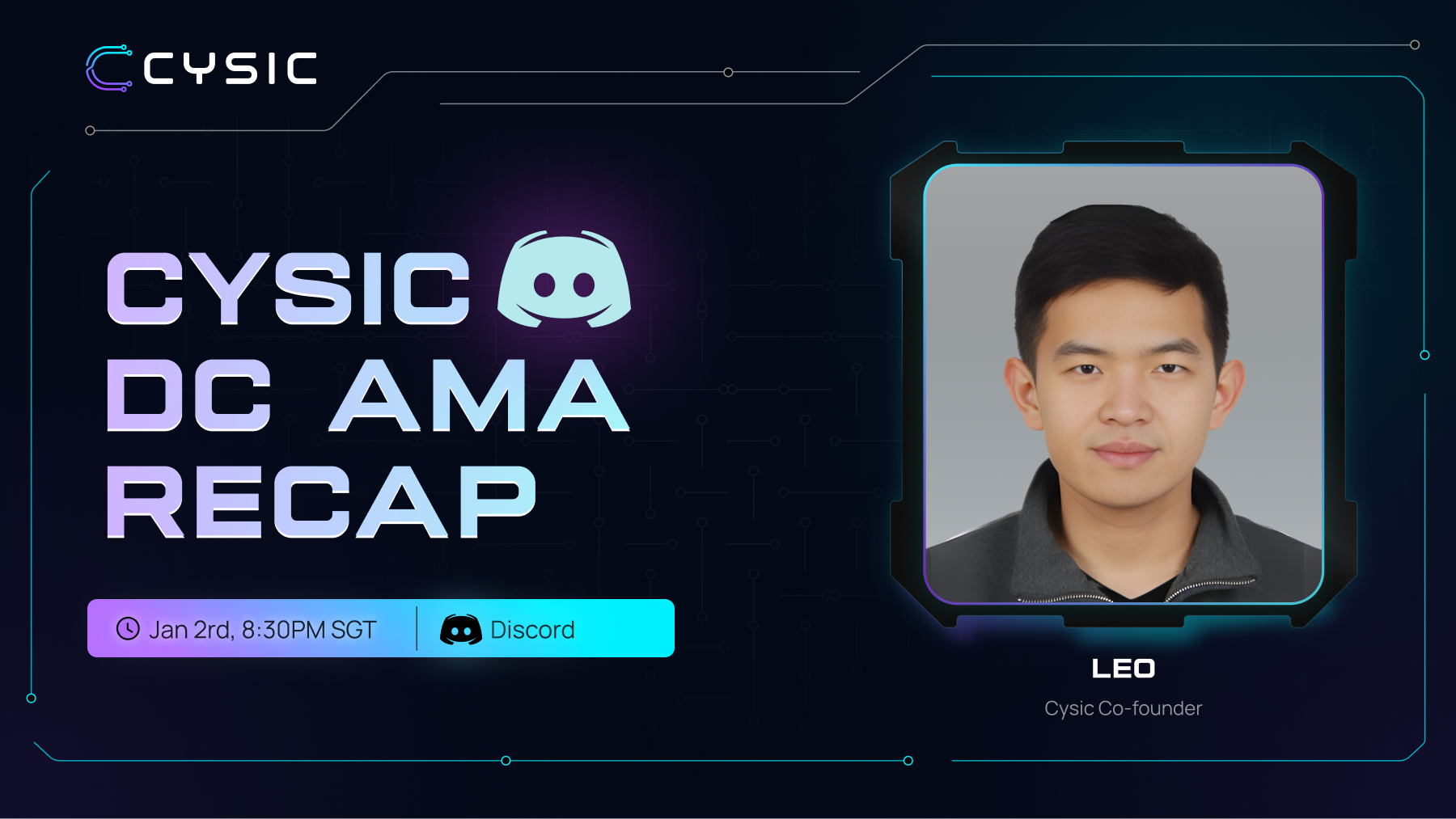
🎙️Leo Community AMA Recap
Jan 9, 2025
Highlights from Our Latest Community Call
Welcome to the recap of our latest bi-weekly Discord AMA! In this session, our founder Leo tackled the community’s burning questions and provided key updates on our mission to make ZK the ultimate endgame. From insights into the Cysic Network to updates on staking, tokenomics, and technical infrastructure, this AMA covered the topics that matter most to you.
We’ve got all the highlights for you in this detailed recap. The recap is divided into two sections: 4 pre-selected questions and 5 community-driven questions.
👉 Join our Discord channel to stay updated!
👉 Schedule our next Discord AMA.
🌴 ZK Proving System Integration
🎙️ Question 1:
How does Cysic handle compatibility with different ZK proving systems such as Plonky2, Gnark, Halo2, and RapidSnark?
👨🏻💻 Leo:
The ZK community has a lot of proof backends, like Plonky2, Plonky3, RapidSnark, and Gnark. But for us, we’re just handling the proof generation for them. For each proof generation task, different servers run these CUDA libraries and gather the necessary data for our customers.
For example, say Customer A is using RapidSnark for proof generation. We get the necessary data from Customer A, run it on a server using the CUDA library, generate the proof, and then send it to the Cysic Network. From there, we hand it back to Customer A. That’s the basic integration process. Of course, we’re working with our customers to continuously improve this integration process.
As for the second part of the question: Right now, proof tasks are assigned in a centralized way. I’ll admit that this is a compromise between efficiency and stability for the chain. At the moment, we’re focusing on strengthening the stability of the Cysic Network. Once it’s strong enough, we’ll decentralize the proof task process, so the community can handle it in a more decentralized way. For now, this centralized approach helps us balance efficiency and stability.
🌴 Cysic Network Staking and Rewards
🎙️ Question 2:
How does Delegate veCompute work? I want to see some kind of payoff. To get the task, we currently have a certain randomness. By staking, delegating, we can increase the percentage of getting a task, it should work as a percentage depending on the contribution. In general, I think that this is how Delegate veCompute works, but I have not found the exact information.
👨🏻💻 Leo:
Basically, you are suggesting that we should have a credit system for provers. If they perform well, then they will have a higher probability to get in the task. That’s a feature we will implement in the future, but not for now. Right now, we’re using a randomized or Round Robin way to assign tasks. These more advanced features, such as by contribution, will be implemented in the future. To be honest, we have already implemented some features and we’re testing the features on the staging environment. When we become stable, we will bring the features from the staging environment to the real environment.
🎙️ Question 3:
Regarding the staking rewards: It is shown on the website as 5%, but the actual situation does not seem to be that much. Will you update the actual staking reward income in the future?
👨🏻💻 Leo:
Our system is programmed to provide a 5% yield for staking, so you should receive 5% of the yield. Please give one of our mods more details, and we will look into it.
🎙️ Question 4:
Why is staking $CGT essential to prevent malicious behavior, and how are the staking and un-staking processes designed to maintain network balance?
👨🏻💻 Leo:
The Cysic Network requires a lot of contribution from the community. You can join the Cysic Network as a prover, as a verifier, or as of validator in the future. The validator part is random and permissioned. If you join the Cysic Network, we rely on you to provide reliable servers to the network: things like generating proofs, verifying proofs, proposing blocks, or voting on blocks.
If someone does something malicious on the network, we have ways to punish them, like slashing some of their tokens. That’s one of the main purposes of staking tokens.
For outsiders, if they see the TVL (Total Value Locked) of the network is high, it gives them more confidence in the project. And if you’re a project using the network, a higher TVL might make you allocate more resources to reliable servers. It’s a positive cycle: the more TVL we have, the more users come to the network. Then the community earns more through staking.
That’s how we achieve a secure and community-friendly environment for everyone.
🌴 Launch and Milestones
🎙️ Community Question 1:
With the mainland launch planned for early 2025, what are the key milestones the team is focusing on over the next month?
👨🏻💻 Leo:
There are several things we need to focus on. First of all, of course, is the quality of our code. We want to make sure there are no bugs in the code. This will involve both internal and external reviews. We’ll also engage well-known auditors to audit our code.
Second, we want to make sure the infrastructure is stable. As you might have noticed, the Cysic Network is currently undergoing some upgrades to the infrastructure. Because of this, we’ve temporarily paused the testnet for a little over a day. We’re also working on providing backup and alternative solutions for the infrastructure to ensure that if one approach fails, there’s always a fallback.
So yeah, those are the two main things. And, of course, we’ll work on attracting more users. We’ll have more marketing plans for the community to help make it better known around the world.
🌴 Tokenomics and TGE
🎙️ Community Question 2:
I wonder if CYS and CGT will be exchanged one-to-one during the TGE period?
👨🏻💻 Leo:
Right now, we have the tokenomics in place. It’s more detailed than what’s in the white paper, and we’re running simulations on it to ensure everything makes sense and considers all possible real-world scenarios. Before the TGE, we’ll announce the conversion ratio to ensure the community is fully informed. Of course, we’ll do everything we can to reward early supporters of Cysic.
🌴 Community Activation and Growth
🎙️ Community Question 3:
Are you preparing a marketing campaign to activate your community?
👨🏻💻 Leo:
Our community is already quite active. Of course, we’re always working on campaigns and promotional programs to attract more users and keep everyone in our community happy with Cysic’s performance.
🌴 Technical Requirements and Infrastructure
🎙️ Community Question 4:
For common verifiers, it was said we’d need at least 8GB of RAM to run them. But now there are announcements about running verifiers on mobile devices.
👨🏻💻 Leo:
I don’t think we still need 8GB of RAM to run verifiers. Before Testnet Phase 2, we significantly reduced the RAM required for running a verifier. Right now, it’s much smaller. For example, if I remember correctly, the mobile application only needs about 260MB, which is way less than 8GB.
Community Question 5:
🎙️ Will the number of data tasks increase?
👨🏻💻 Leo:
Of course, we’ll be adding more tasks to the Cysic Network. Cysic is already doing a lot of proof generation for the community, and since the network is now stable, we’re able to plug in more tasks for the community to handle proof generation.
About Cysic
We are accelerating Zero-Knowledge Proofs with Next-Gen Compute. Instant Proofs, Infinite Possibilities.
Cysic is home to the leading real-time ZK Proof Layer, featuring state-of-the-art hardware. Our mission is to hyperscale the ZK revolution by delivering Zero-Knowledge Proofs with unmatched speed, simplicity, and cost-efficiency. Cysic’s innovative product suite includes the Cysic Network, which decentralizes and streamlines proof generation and verification, powered by our ASICs, ZK Air and ZK Pro. ZK Air fuels lightweight, seamless client-side proof generation, while ZK Pro turbocharges high-performance server-side proof generation.
Our team is dedicated to pushing the boundaries of cryptographic efficiency, ensuring that ZK technology is accessible, secure, and ready to meet the demands of tomorrow’s decentralized world.
For more information, welcome to join the Cysic Community!
Keep exploring Cysic
CyAI: The Decentralized AI Built by Cysic
An open market for verifiable AI inference—moving from trusting a provider to trusting an auditable protocol.
Open-Sourcing Venus: A New Foundation for High-Performance zkVMs
Over the past months, we published a three-part series on how zkVMs should be built, from architectural philosophy to hardware…
zkVM Trilogy (Part III): Building a Production zkEVM Node
Who this post is for: Technical project managers, protocol engineers, and ecosystem participants interested in our concrete execution plan…